Overview
Every bank app already has all the data it needs to be genuinely useful. And yet almost none of that information is presented in a way anyone actually understands — it is a ledger, not an answer.
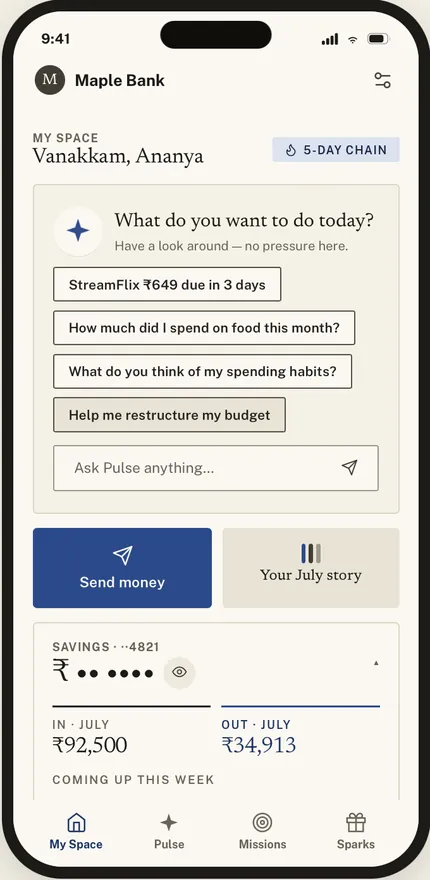
Wisr is not a new bank or another dashboard. It is a conversational layer that sits on top of information a bank already has and translates it into something a person actually wants to read.
The Surfaces
“The core design problem was not visual — it was linguistic. A bank’s existing data is only useful if it is said in a way a person would actually want to hear.”
Interaction Model
Observation, then a real question
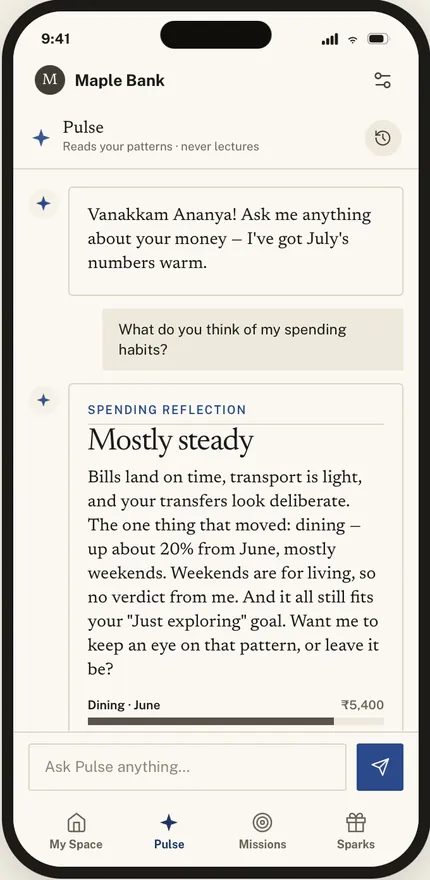
The pattern that emerged became the product’s signature interaction. Instead of a flat statement, the assistant names what changed in specific human terms, then asks what the user wants to do about it. That answer is remembered, so the same observation never repeats as a nag.
Language
English, with a flavour
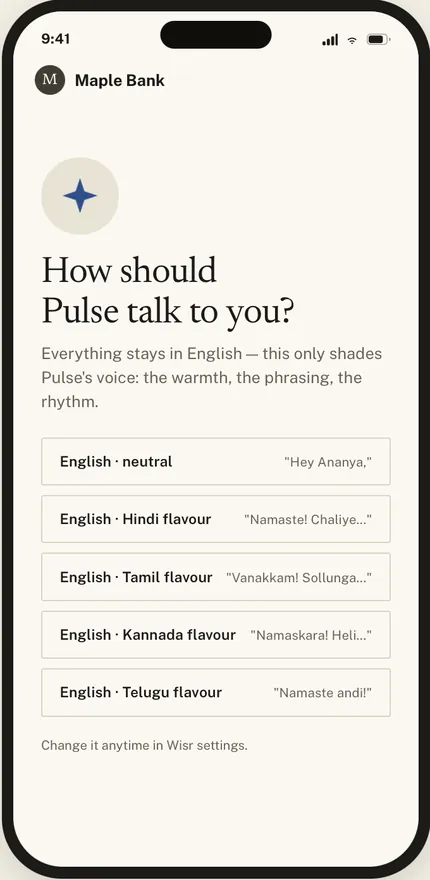
The voice is the first thing the user picks, before any account data is touched. The same observation can be said warmly, plainly, or with a bit of edge — and which one you get is a choice the user makes rather than a tone the product assumes.
Constraint
RBI dark-pattern guidance
Nothing in the product may pressure, shame, or manufacture urgency to move money. Prompts offer a choice and accept no as an answer.
Consent
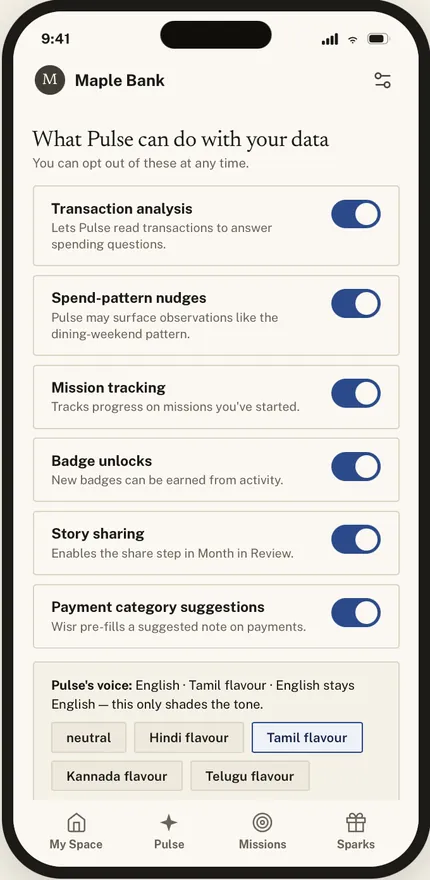
A permission per capability
Consent was treated as a foundational decision, not an afterthought. Every capability is its own plain-language, independently toggleable permission, presented with the same conversational clarity as everything else in the product. The permission model was designed alongside the very first screen.
Design
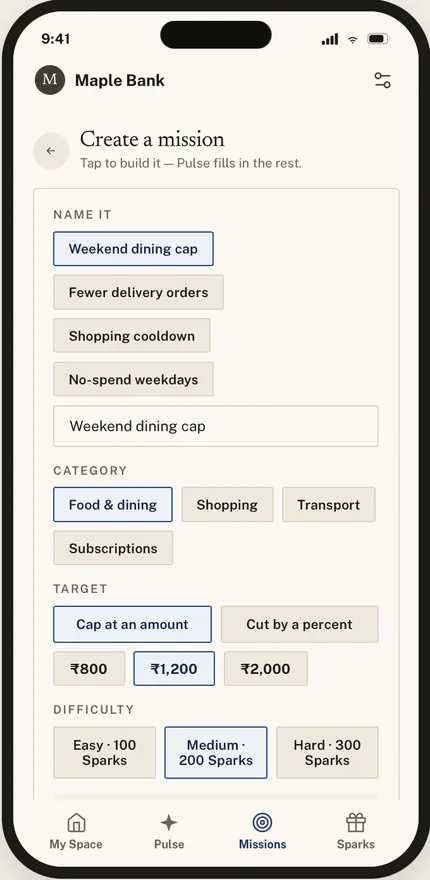
The screens
Outcome
A fully clickable prototype built entirely through natural-language prompting in Claude Design, ready for real user testing.
Next Phase
What started as a provocation — what if your banking app talked to you like it understood your money — became a structured product with a defined permission model, a tonal framework, and a mechanic that turns passive data into genuine back-and-forth.
Reflection
Because Wisr does not own the underlying banking relationship, every feature had to be designed around information the host app already has. This shaped a quiet mechanic: at the moment of payment, Wisr makes an informed guess about what kind of payment it is and offers to pre-fill the note — always visibly editable, never assumed. The same principle as the core conversation: take what already exists in the system, and make it more human at the exact moment it matters.