Overview
Home buyers visit five times, check every wall, every tap, every socket. And something still slips through. That is not a failure of diligence — it is the nature of buying a home, and it is the anxiety Nestora is built around.
The category brief described BuildTech and real estate as fragmented, opaque and inefficient, with minimal use of AI for personalisation, prediction or risk assessment.
The Root Cause
Six themes surfaced across the interviews — trust barrier, lack of transparency, expectation versus reality, fragmented experience, loan stress, mistrust in agents. Every one pointed back to the same thing: buyers had no way to independently verify what they were being told.
“Buying property today requires a lot of trust, which is difficult with unknown builders.” — research participant
Decision
Trust was the strategy, before it was a feature
The first thing built in the immersion was not a wireframe, it was a strategy. Trust — not convenience, not speed — was named the chief pain point worth designing around, and the six-stage shift followed from it: verified discovery and AI matching, smart shortlisting and transparent site visits, instant legal due diligence, all-inclusive financial clarity, demystified construction, quality-assured handover.
Decision
Where AI earns its place, and where it doesn’t
AI carries discovery, evaluation and post-booking: preference-focused results, AI-assisted legal checks, escalation forecasting, construction tracking. Dynamic Pricing AI and Adaptive Learning Systems were explored and deliberately set aside — both optimise for platform outcomes rather than the buyer’s own certainty, which is the opposite of what Nestora is for. AI can answer at 2am; it cannot photograph a damp wall. That row stayed a human operational cost, and it is what lets the product claim independence.
Process
Three builds, three rounds of listening
V1 · five-day sprint
Right instinct, broken execution. Emotion tracking and heatmaps ran alongside the usability sessions: attention pooled on price and the dismiss control, not on the trust signals the screen was built to foreground. No participant rated the overall experience above a 4.
V2 · five structural fixes
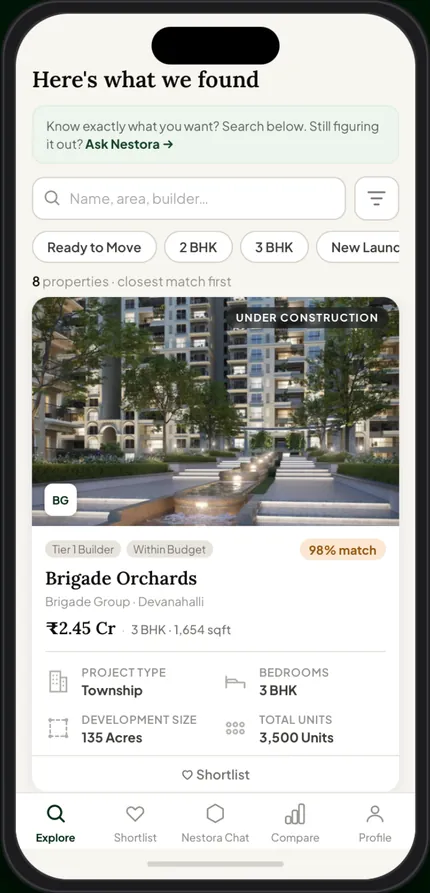
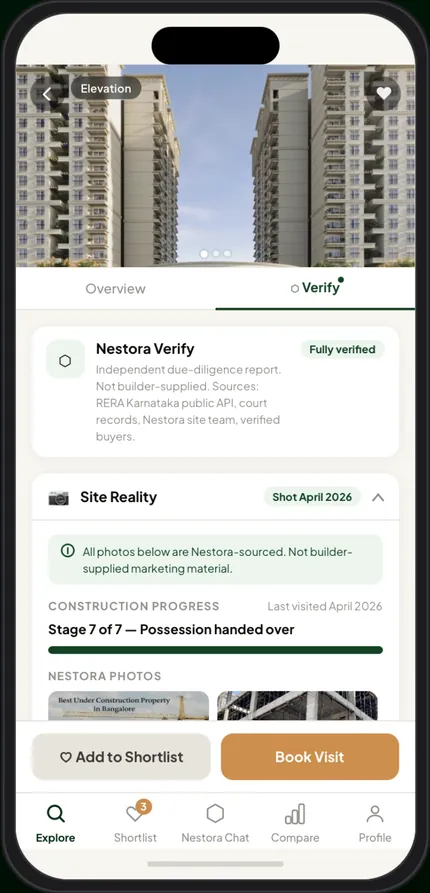
Ranked multi-priority onboarding, full-text search with an open locality input, expandable match rationale, a dedicated Nestora Verify tab with honest pending and scheduled states, and shortlist separated from compare. It felt like a real app for the first time.
The class review was sharper than any usability test: You have put together a bunch of features as opposed to an experience.
V3 · working solo
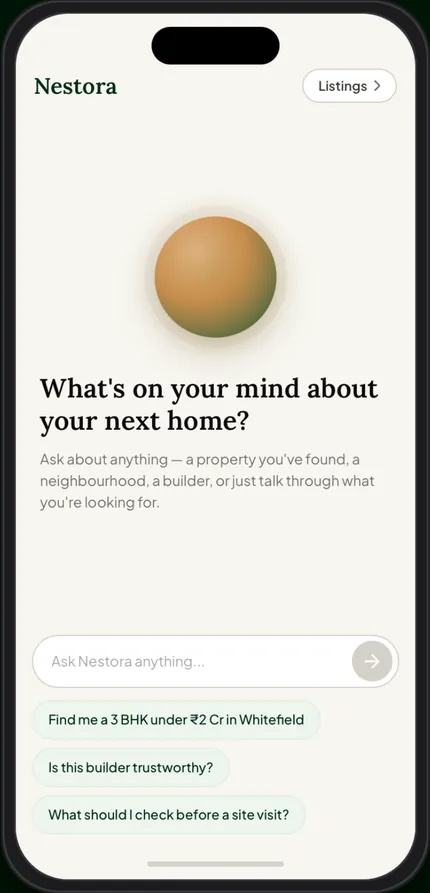
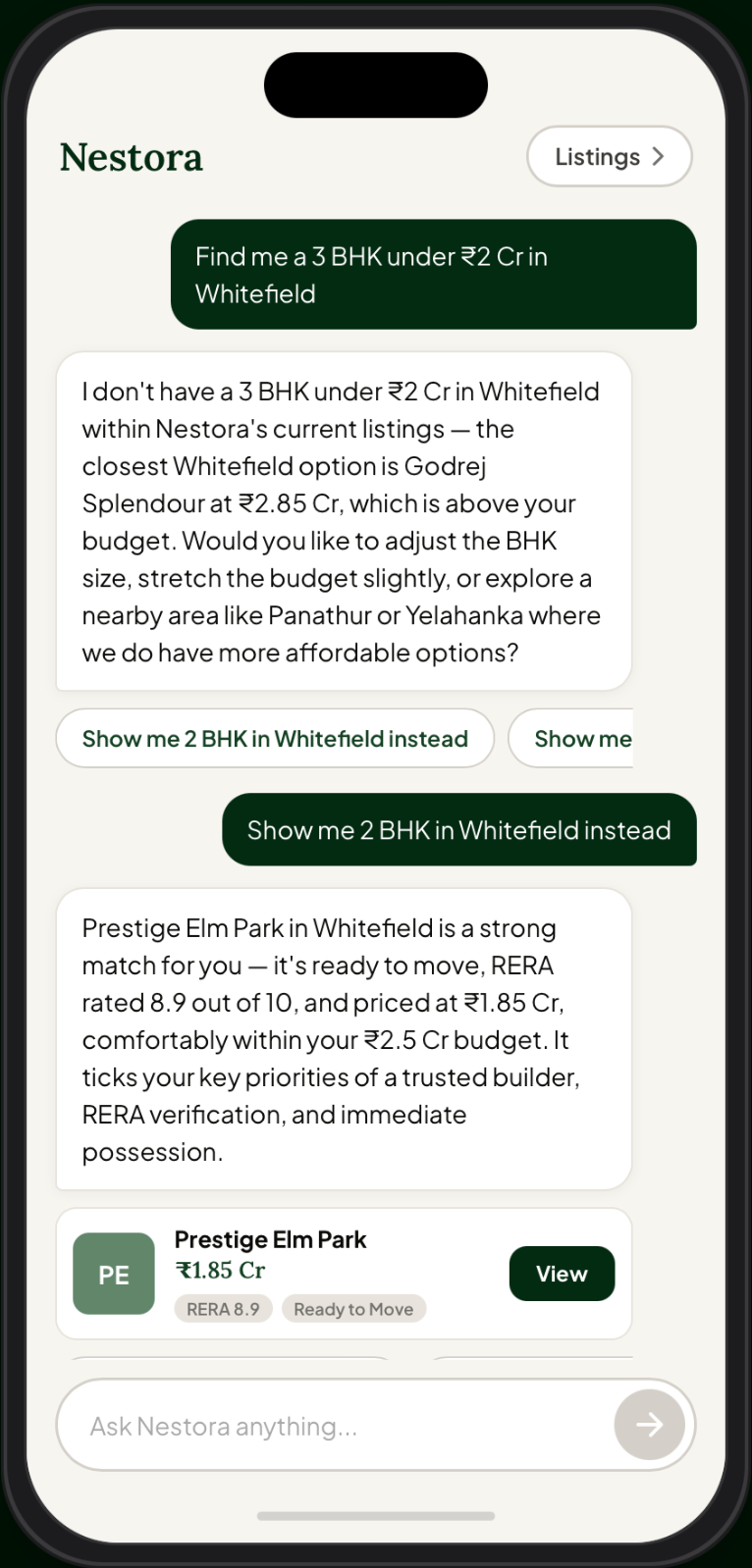
Nestora Chat became its own tab. Chat and search were kept deliberately separate rather than merged into one smart bar. Real elevation photography and dated, Nestora-sourced construction photos replaced builder renders.
Design
Five screens, each carrying one decision
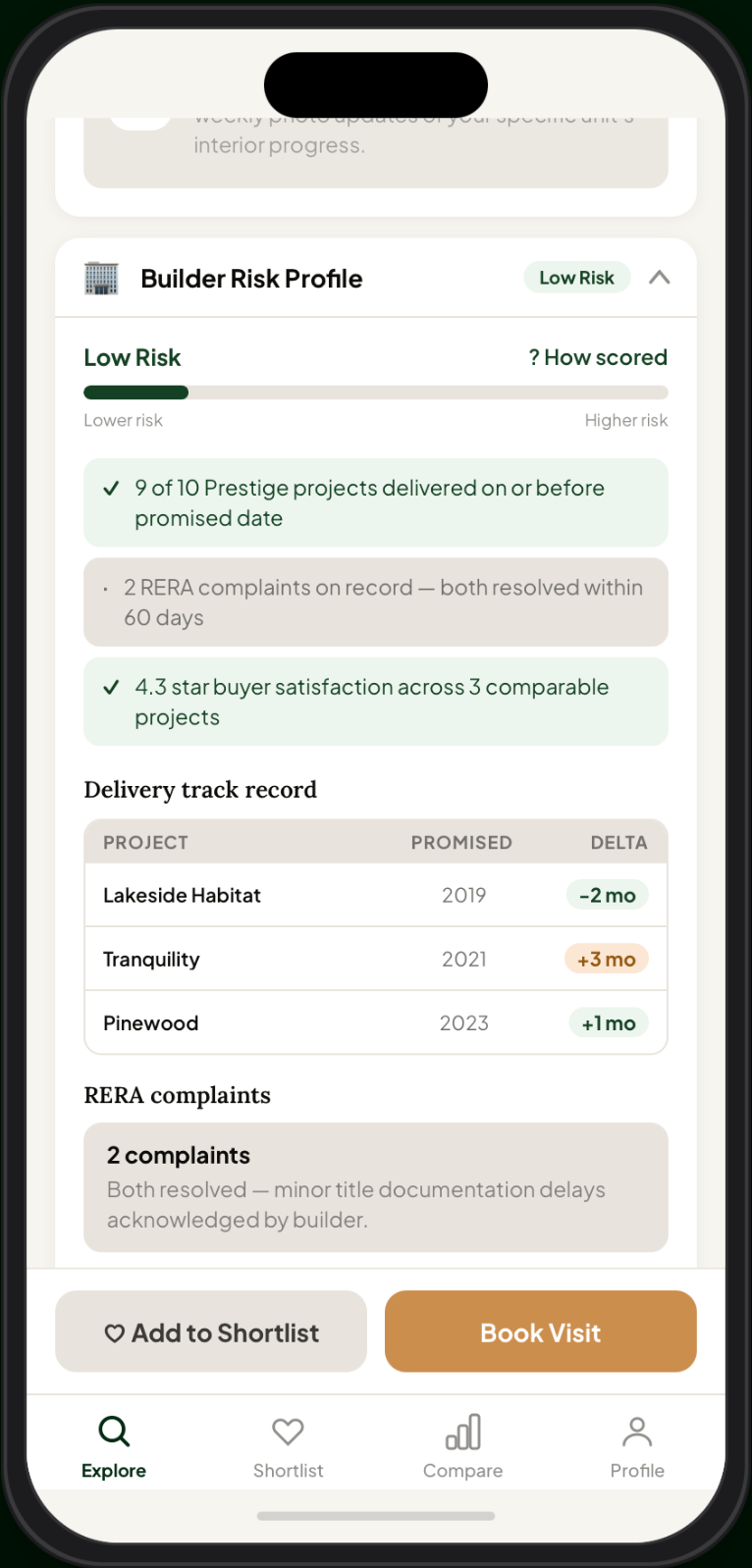
Outcome
Three versions in, the emotional core held: trust, named and addressed directly. V3 tested as more unique and more trustworthy than either version before it. What had not landed was the feeling of it — users said it lacked the “WOW factor” and could not articulate why when probed.
The business case was modelled alongside: on a single-city Bangalore launch at roughly 2.2% baseline visitor-to-lead, the priority engine and Verify together model between ₹0.46 Cr and ₹5.93 Cr of additional annual revenue depending on conversion lift.
Next Phase
V4 starts by diagnosing rather than building. Run a salted brand test — target attributes against decoy attributes, benchmarked on two incumbent BuildTech apps — because “lacks WOW” is a brand-perception finding, not a usability one, and every task was already completable. Then extend the journey map through the post-possession stages where stress peaks, close the three usability criteria still marked not re-measured, and test whether the product needs two arousal registers rather than one.
Reflection
The interface was deliberately calibrated for low arousal: muted palette, no countdown timers, no “three people viewing”, celebration held back for handover where it is earned rather than manufactured. Buying a home is the highest-stakes decision most buyers will make, and high arousal degrades performance on exactly that kind of task — so the restraint was correct.
Applying it everywhere may not have been. Arousal calibration is set by persona, scenario and task together, and finding a home you might live in is not the same task as scrutinising a title deed. One is aspirational, the other forensic. V3 applies a single register to both, and that uniformity is a credible source of the missing WOW.